I have been thinking how our view of the child influences what we see as "appropriate" use of technology. In fact it goes further than that to what kinds of activities we think children should participate in at all. Obviously anyone's thinking in this area can not be polarised into black or white generalisations but rather they reflect a continuim.
At the heart of my view of the child is a sense of my responsibility as an adult and a parent to facilitate their development towards adulthood. More than that I think a young child as a learner is programmed to watch for those learning moments which build their skills to participate in the world. So my children share in my life and activities. If my life and activities include talking to someone on the phone, I expect my child to be interested in talking on the phone and I do a range of things to support that learning. I provide toy phones to explore, let them listen to someone say hello on the other end, help them understand that you need to speak clearly to be heard, and gradually build thier skills so that at some point they can make a phone call, answer the phone and communicate clearly by phone.
The natural extension of this for computers is that if my children see me on a computer that is another tool for them to explore with me. I cant imagine anyone refusing to let a child explore the world of telephones although we might put some limitations on how and when they do that exploration. The question wouldn't be about wether it is appropraite to learn how to use the telephone but rather the parameters within which that learning will take place.
Tuesday, April 04, 2006


Tuesday, March 21, 2006
Using an "old" ICT
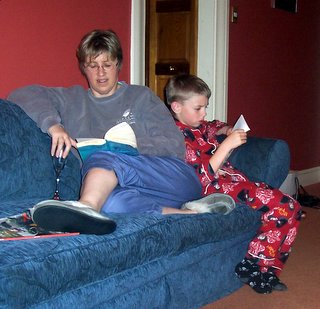 One thing I feel quite strongly about is that the use of digital technology doesn't preclude my children's use of "traditional" forms of ICT. A book is a form of information communication technology. Jonathan might be a thriving digital native in a cyberworld but he loves to read as well. One of the first uses my middle dd put the internet to was searching Amazon for books. She was 9 at the time and while a confident reader not particularly engaged by the books available locally. Those Amazon experiments where she could read reviews as well as about the book itself had her exploring a wider range of books and were a significant step to her view of herself as a good reader. The photo was taken about a week ago on a Saturday night.
Sunday, March 19, 2006
Introducing us
Hi I'm Jonathan and I am 7.
And I am Sonja, his mother!
and Sonja is my mum and she is funny.
I started this blog as a place to try out some ideas about young children, computers, the net and other digital technologies. As a parent of five children aged 24, 22, 18, 16 and 7 with a commitment to encouraging them to be lifelong learners I find Marc Prensky's work about digital immigrants and a digital natives makes a lot of sense.
All my children have been exposed to computers from their earliest years. My eldest son and daughter first got to try out simple draw programming in the early 1980's with my father's Sinclair! We had our own computer from 1986 - an early Amstrad. Once that was obsolete there was a bit of a gap for a while where we tended to use my dh's or my work laptops before we got a Pentuim desktop in 1998. From then we rapidly moved to being a multi-computer family with 4 computers by the end of 1999, 5 in 2001 and then some major upgrading in the last couple of years. We run a combined ethernet/wireless home network using a high speed connection.
One of the reasons for the gap in the 90's was my reluctance to engage with computers as entertainment. One of the fairly rigid rules in our family is that violent, first person shooter games are not acceptable and most of our software titles are simulations, logic puzzles, and strategy games. Having just watched my 16 year old fighting a battle in Civilisation 4 simulations being "better" is probably a little niave but it works for us.
This blog starts with a sentence from my 7 year old who came in as I was setting it up, and wanted to write in the space. He already e-mails his grandparents, older brother and sister and friends, occassionally his teacher. And it is his experience of technology that fascinates me.
Prensky talks about immigrants and natives - I live with the son of an immigrant (a native New Zealander with Dutch parents) and as a first generation native he can cross between both worlds. In my house we have some first generation natives but for want of a better description Jonathan is a second generation native.
For him use of the internet, e-mail, digital imaging, digital sound has been part of his life since birth. My strongest ongoing parenting support network is an online community of women who are mothers of children born in the same month as him. He has a bulletin board of photos of his birthday "buddies" which is updated every year around their birthdays. He e-mails some of them and has even met several of them and their families.
Yet very little of this is recognised at all within his school environment he spends so much of his time in. Last week he spent several hours "playing" on a website that supports basic spelling, grammer, and maths fact acquistion. He probably did over a hundred "basic facts" in the course of a game but is likely to be expected to do the 10 basic facts on the homework sheet he missed getting.
I get really tired of the debates about what he isn't doing by spending time on a computer, but that is a topic for another post.
Sonja
And I am Sonja, his mother!
and Sonja is my mum and she is funny.
I started this blog as a place to try out some ideas about young children, computers, the net and other digital technologies. As a parent of five children aged 24, 22, 18, 16 and 7 with a commitment to encouraging them to be lifelong learners I find Marc Prensky's work about digital immigrants and a digital natives makes a lot of sense.
All my children have been exposed to computers from their earliest years. My eldest son and daughter first got to try out simple draw programming in the early 1980's with my father's Sinclair! We had our own computer from 1986 - an early Amstrad. Once that was obsolete there was a bit of a gap for a while where we tended to use my dh's or my work laptops before we got a Pentuim desktop in 1998. From then we rapidly moved to being a multi-computer family with 4 computers by the end of 1999, 5 in 2001 and then some major upgrading in the last couple of years. We run a combined ethernet/wireless home network using a high speed connection.
One of the reasons for the gap in the 90's was my reluctance to engage with computers as entertainment. One of the fairly rigid rules in our family is that violent, first person shooter games are not acceptable and most of our software titles are simulations, logic puzzles, and strategy games. Having just watched my 16 year old fighting a battle in Civilisation 4 simulations being "better" is probably a little niave but it works for us.
This blog starts with a sentence from my 7 year old who came in as I was setting it up, and wanted to write in the space. He already e-mails his grandparents, older brother and sister and friends, occassionally his teacher. And it is his experience of technology that fascinates me.
Prensky talks about immigrants and natives - I live with the son of an immigrant (a native New Zealander with Dutch parents) and as a first generation native he can cross between both worlds. In my house we have some first generation natives but for want of a better description Jonathan is a second generation native.
For him use of the internet, e-mail, digital imaging, digital sound has been part of his life since birth. My strongest ongoing parenting support network is an online community of women who are mothers of children born in the same month as him. He has a bulletin board of photos of his birthday "buddies" which is updated every year around their birthdays. He e-mails some of them and has even met several of them and their families.
Yet very little of this is recognised at all within his school environment he spends so much of his time in. Last week he spent several hours "playing" on a website that supports basic spelling, grammer, and maths fact acquistion. He probably did over a hundred "basic facts" in the course of a game but is likely to be expected to do the 10 basic facts on the homework sheet he missed getting.
I get really tired of the debates about what he isn't doing by spending time on a computer, but that is a topic for another post.
Sonja
Subscribe to:
Posts (Atom)